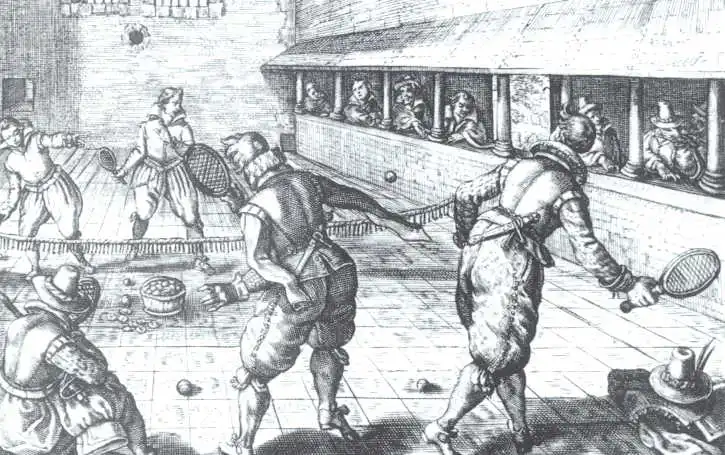
Within a year of Wingfield’s patent, the game had crossed the Atlantic. Mary Ewing Outerbridge, a young American socialite, encountered it in Bermuda and brought back equipment to the Staten Island Cricket and Baseball Club in New York — establishing, by most accounts, the first tennis court in the United States.
III. Wimbledon and the Birth of Organised Tennis
The All England Croquet and Lawn Tennis Club at Wimbledon held its first championship tournament in 1877. Twenty-two men entered. Spencer Gore, a rackets player, won. The prize was a 12-guinea silver challenge cup. The crowd numbered in the hundreds.
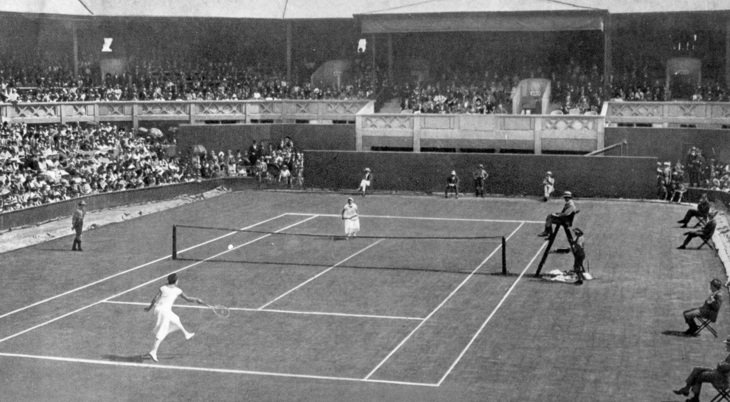
Few sporting events in history have been so humble in their beginnings and so monumental in their legacy. Wimbledon formalised the rules — adopting the rectangular court over Wingfield’s original hourglass shape — established the precedent of an annual championship, and gave the sport its spiritual home. The sight of strawberries and cream, the strict white dress code, the hallowed hush of Centre Court before a crucial second serve: these traditions would define the game’s identity for generations to come.
Key Milestones in Tennis History
IV. The Surfaces That Shaped the Game
Tennis is unusual among major sports in that its playing surface changes absolutely everything — the bounce, the pace, the tactical demands, even the physical toll on a player’s body.For most of the sport’s early history, grass reigned supreme. The rise of hard courts from the 1970s onward reflected changing economics as much as aesthetics: harder surfaces are cheaper to maintain, more consistent for television, and more forgiving on club budgets worldwide.
The Original Surface
The Red Battlefield
The Modern Standard
Fast, skiddy, and steeped in
tradition. Wimbledon’s lawns
reward aggressive serve-and-
volley play and punish
baseline sluggishness.
Slow and unforgiving, clay
rewards baseline endurance
and heavy topspin. Roland
Garros’ crushed red brick has
broken the greatest
champions.
Consistent and neutral, hard
courts became the dominant
surface of the modern era —
home to the US Open and
Australian Open alike.
V. The Golden Age of Amateur Champions
The 21st century brought with it something the sport had never seen before: a sustained, decades-long era of dominance by three players so exceptional that even the most seasoned observers ran permanently short of adequate superlatives. Roger Federer, Rafael Nadal, and Novak Djokovic — the “Big Three” — would collectively accumulate over 60 Grand Slam singles titles, pulverising records that had stood for decades.
Federer’s artistry redefined what elegance looked like at speed. Nadal’s volcanic intensity on clay — and his almost incomprehensible refusal to accept that any point was lost until the ball had bounced twice — redefined competitive resilience. Djokovic’s systematic, methodical improvement over two decades produced a player whose statistical record remains, in the mid-2020s, without peer.
On the women’s side, Serena Williams stands as perhaps the most dominant individual champion in the sport’s history across either gender — 23 Grand Slam singles titles, a career spanning from teenage sensation in 1999 to veteran competitor in the 2020s, and a cultural impact on sport, fashion, and discussions of race in America that extended far beyond any court surface.
VI. 1968: The Year That Changed Everything
By the mid-1960s, a painful contradiction had taken root. The sport’s greatest players were prohibited from competing in the Grand Slams the moment they accepted professional contracts. The tournaments that mattered most were contested by amateurs who were, by definition, often not the finest players in the world. The hypocrisy had finally become impossible to defend.
In 1968, the French Open in May became the first Grand Slam to admit professional players, and within weeks, Wimbledon followed suit. The Open Era had arrived — and with it, prize money, commercial sponsorship, global television rights, and the transformation of tennis from a genteel pastime into one of the most lucrative and widely broadcast sports on the planet.
The slow-burning rivalry between Jimmy Connors and Björn Borg gave way to the operatic confrontation between Borg and John McEnroe. Their 1980 Wimbledon final, still cited by historians as one of the greatest matches ever played, introduced millions of new spectators to tennis. On the women’s side, the 80-meeting career rivalry between Chris Evert and Martina Navratilova proved that women’s tennis could generate the same level of narrative drama and passionate following as any sport on earth.
VII. The Modern Dynasty Era
The 21st century brought with it something the sport had never seen before: a sustained, decades-long era of dominance by three players so exceptional that even the most seasoned observers ran permanently short of adequate superlatives. Roger Federer, Rafael Nadal, and Novak Djokovic — the “Big Three” — would collectively accumulate over 60 Grand Slam singles titles, pulverising records that had stood for decades.
Federer’s artistry redefined what elegance looked like at speed. Nadal’s volcanic intensity on clay — and his almost incomprehensible refusal to accept that any point was lost until the ball had bounced twice — redefined competitive resilience. Djokovic’s systematic, methodical improvement over two decades produced a player whose statistical record remains, in the mid-2020s, without peer.
On the women’s side, Serena Williams stands as perhaps the most dominant individual champion in the sport’s history across either gender — 23 Grand Slam singles titles, a career spanning from teenage sensation in 1999 to veteran competitor in the 2020s, and a cultural impact on sport, fashion, and discussions of race in America that extended far beyond any court surface.
VIII. The Game Today — and Where It Is Headed
As the Big Three era draws gradually to a close, a new and exceptionally talented generation has stepped into the spotlight. Carlos Alcaraz, who captured his first Grand Slam at just 19 years old at the 2022 US Open, embodies everything the sport’s next chapter promises: electrifying speed, inventive shot-making, and a natural charisma that fills arenas. Jannik Sinner, Iga Świątek, Aryna Sabalenka, Coco Gauff — the mid-2020s are witnessing one of tennis’s periodic generational renewals.
Through every controversy and every chapter of brilliance, tennis retains the elemental quality that has drawn people to it for seven centuries. It is, at its irreducible core, two individuals on opposite sides of a net, separated by nothing but skill, nerve, and the unpredictable flight of a felt-covered ball. From the stone-floored cloister courtyards of medieval France to the floodlit arenas of the 21st century, that fundamental drama — intimate, unforgiving, and endlessly compelling — has never grown old.
“Seven centuries after a monk first struck a ball against
a monastery wall, the rally is still going. And it shows
no sign of stopping.”